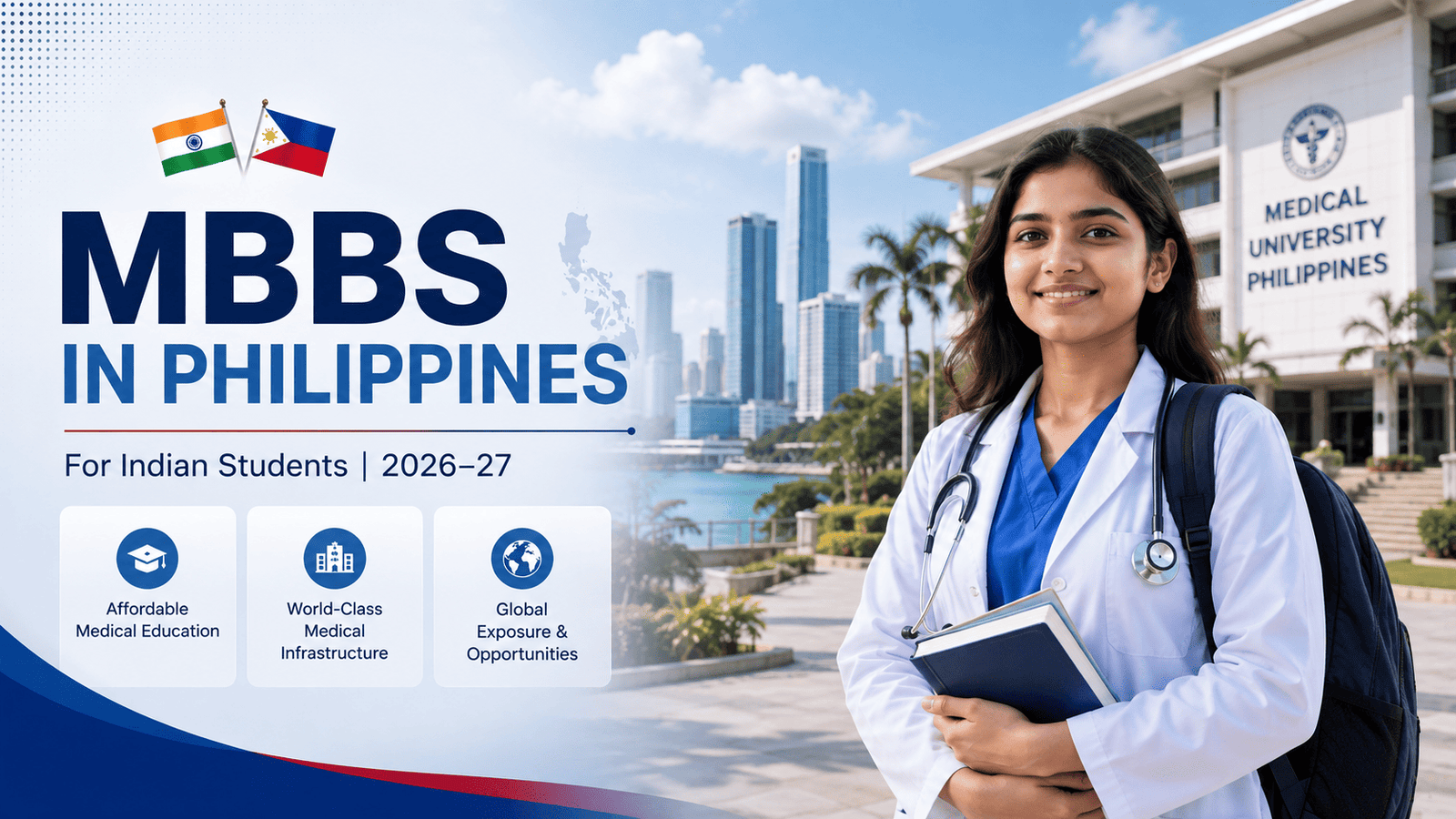
The Philippines is an increasingly considered destination for Indian students who want to pursue medical education abroad in an English-speaking environment. Medical education in the country follows a structured system that combines foundational science education with clinical medical training. Several institutions offer medical programs designed around classroom learning, laboratory work and clinical exposure.
For Indian students, the Philippines can be attractive because English is widely used in education and healthcare, and the country offers exposure to an international student environment. However, students should carefully verify the current NMC requirements, university recognition, admission route, course structure and internship requirements before applying.
The medical program in the Philippines is commonly structured differently from the traditional five-and-a-half-year MBBS pathway followed in India. Many universities use a BS/Pre-Medical + Doctor of Medicine (MD) structure, so students should understand the complete academic pathway before taking admission.
With proper research and selection of an eligible institution, studying medicine in the Philippines can provide students with international academic exposure and clinical learning opportunities.
Study MBBS in Philippines for Indian Students 2026–27
Studying medicine abroad has become an option for Indian students who are unable to secure a preferred medical seat in India. The Philippines is one of the destinations considered by international medical aspirants because of its English-speaking environment, established medical education system and exposure to a diverse patient population.
Medical education in the Philippines follows a structure that is different from the conventional MBBS system in India. Depending on the university and program, students may first complete a pre-medical or undergraduate science component before entering the Doctor of Medicine (MD) program. Therefore, Indian students should understand the complete course structure, admission requirements and duration before selecting a university.
The Philippines also offers students an opportunity to study in an environment where English is extensively used in education and healthcare. This can make classroom learning and communication comparatively convenient for Indian students.
However, recognition and eligibility requirements are particularly important for Indian students. Before admission, students should verify whether the selected institution and qualification satisfy the current National Medical Commission (NMC) rules applicable to Indian students studying medicine abroad.
MBBS in Philippines at a Glance
Particular
Details
Country
Philippines
Capital
Manila
Medical Degree
Doctor of Medicine (MD) / university-specific medical qualification
Course Structure
Pre-medical/undergraduate stage + Medical Doctor program, depending on university
Medium of Instruction
Primarily English
Eligibility
10+2 with Physics, Chemistry and Biology/PCB as applicable + NEET qualification for Indian students
Admission Intake
Varies by university
NEET
Required for Indian students as per applicable NMC rules
Clinical Training
Included as part of medical education
Currency
Philippine Peso (PHP)
Major Medical Education Cities
Manila, Quezon City, Valenzuela, Laguna and other locations
International Students
Accepted by several medical institutions
Recognition
Must be verified individually for the chosen institution and qualification
Internship/Clinical Requirements
Depend on university, program and applicable regulatory requirements
Important: Course duration, fee, admission tests and academic structure can vary significantly between Philippine medical schools. Students should not rely on a single generic duration or fee figure.
Why Study Medicine in the Philippines?
The Philippines can be considered by Indian medical aspirants for several academic and practical reasons.
1. English-Based Medical Education
English is widely used in Philippine higher education and healthcare. This can make it easier for international students to understand lectures, textbooks and medical terminology.
2. International Student Environment
Medical institutions in the Philippines have experience educating students from different countries. This gives students an opportunity to interact with classmates from diverse cultural backgrounds.
3. Exposure to Clinical Learning
Medical education combines theoretical knowledge with laboratory and clinical learning. Depending on the university, students may receive clinical exposure through affiliated hospitals and healthcare facilities.
4. Different Medical Education Pathway
The Philippine system commonly uses a pre-medical education followed by a Doctor of Medicine program. Students should understand this structure before comparing it with MBBS programs in other countries.
5. English-Speaking Healthcare Environment
Students can communicate with many healthcare professionals and patients in English, although local languages are also widely spoken.
6. International Exposure
Living and studying abroad can help students develop communication skills, independence and cross-cultural understanding.
7. Medical Infrastructure
Several established Philippine medical institutions have teaching hospitals, laboratories, simulation facilities and other academic resources.
8. Diverse Patient Exposure
Students may encounter patients with a variety of medical conditions during clinical training, subject to their university's hospital affiliations and clinical rotation structure.
MBBS/MD Course Structure in the Philippines
One of the most important things Indian students need to understand is that medical education in the Philippines is not always structured like the MBBS course in India.
Many Philippine institutions follow a pathway broadly involving:
Pre-Medical/Undergraduate Education → Doctor of Medicine → Clinical Training/Internship → Licensure
The exact pathway varies between institutions.
Pre-Medical Education
The initial stage may focus on subjects related to biological sciences, chemistry, physics, psychology and other foundational areas.
This stage helps students develop the academic foundation required for medical studies.
Doctor of Medicine Program
After completing the required prerequisite education, eligible students proceed to the Doctor of Medicine program.
The curriculum generally includes subjects such as:
Anatomy
Physiology
Biochemistry
Histology
Microbiology
Pathology
Pharmacology
Parasitology
Community Medicine
Internal Medicine
Surgery
Pediatrics
Obstetrics and Gynecology
Psychiatry
Ophthalmology
ENT
Radiology
Legal Medicine
Clinical Training
During the clinical phase, students receive practical exposure through hospitals and affiliated healthcare facilities. The exact duration and rotation pattern depend on the institution and applicable regulations.
Duration of Medical Education in Philippines
There is no single duration that applies identically to every medical program in the Philippines.
Some institutions follow an undergraduate/pre-medical stage followed by a Doctor of Medicine program. Therefore, Indian students should consider the complete pathway from entry into the university until completion of the medical qualification, rather than comparing only the duration of the MD component.
A typical pathway may include:
Stage
Academic Focus
Pre-Medical Stage
Basic and biological sciences
Medical School
Pre-clinical and clinical medicine
Clinical Rotations
Hospital-based practical training
Internship/Required Training
Practical medical experience, depending on program
Before admission, students should obtain the university's current curriculum and official duration in writing.
Eligibility for Indian Students
Indian students planning to study medicine in the Philippines should satisfy the academic and regulatory requirements applicable to foreign medical students.
Generally, applicants should have:
Completed Class 12 or equivalent qualification.
Studied Physics, Chemistry and Biology/Biotechnology as required.
Fulfilled the minimum academic requirements prescribed under the applicable Indian regulations.
Qualified NEET-UG, where required under current NMC rules.
Meet the age requirement applicable to NEET and medical admission.
Fulfil the admission requirements of the selected Philippine institution.
Meet visa and immigration requirements for international students.
NEET Requirement
For Indian students, NEET qualification is an important requirement for studying medicine abroad under the applicable Indian regulations.
Students should check the current NMC/NEET requirements for the academic year in which they are applying, because regulatory requirements can change.
NEET Requirement for MBBS in Philippines
NEET plays an important role for Indian students planning to pursue medical education abroad.
A student should:
Appear for NEET-UG.
Qualify NEET according to the applicable eligibility criteria.
Select a medical institution that meets the relevant requirements.
Check whether the complete course structure complies with current NMC regulations.
Maintain all NEET-related documents for the admission process and future regulatory requirements.
A low NEET score does not automatically mean that every foreign medical university will be suitable. Students must still satisfy the university's admission criteria and India's regulations for foreign medical graduates.
Admission Process for MBBS in Philippines
The admission process varies from university to university. A general process for Indian students may include the following steps:
Step 1: Qualify NEET
Indian applicants should first satisfy the applicable NEET requirement.
Step 2: Select a Medical University
Compare universities based on:
Recognition
Curriculum
Course duration
Clinical training
Hospital affiliations
Tuition fees
Accommodation
Location
International student support
Compliance with current NMC requirements
Step 3: Submit Application
Students submit the university application along with academic and identity documents.
Step 4: Academic Evaluation
The university reviews the student's academic qualifications and other admission requirements.
Step 5: Admission/Offer Letter
Eligible students receive the relevant admission or acceptance document from the institution.
Step 6: Complete University Formalities
Students complete fee payment and other required institutional procedures.
Step 7: Student Visa
After receiving the necessary university documents, students can proceed with the applicable student visa process.
Step 8: Travel and University Registration
After obtaining the required visa/entry clearance, students travel to the Philippines and complete university registration and orientation.
Documents Required
Indian students should generally keep the following documents ready:
Class 10 certificate and mark sheet
Class 12 certificate and mark sheet
NEET scorecard
NEET admit card, where applicable
Passport
Passport-size photographs
Birth certificate, where required
School leaving/transfer certificate
Medical fitness certificate
Character certificate
Police clearance or other background documents, where required
University application form
Admission/acceptance letter
Financial documents, where required
Visa-related documents
Other documents requested by the university or Philippine authorities
The exact document list can differ between institutions.
Recognition of Medical Education in Philippines
Recognition is one of the most important factors for Indian students.
Students should not assume that every medical institution in the Philippines automatically qualifies for practice in India.
Before paying any admission fee, students should verify:
Status of the institution
Status of the medical qualification
Current NMC requirements
Course duration
Medium of instruction
Clinical training
Internship requirements
Eligibility for registration/licensure in the country of study
Whether the complete program meets the requirements applicable to Indian foreign medical graduates
NMC Recognition
For Indian students, the relevant NMC regulations should be checked before admission.
The recognition status of a university should be verified based on the current regulations and official records, rather than relying only on claims made by consultants or third-party websites.
Medium of Instruction
English is one of the major advantages often associated with medical education in the Philippines.
Medical textbooks, lectures and academic communication are commonly conducted in English in many institutions.
However, students may still encounter Filipino and other local languages during daily life and clinical interactions.
Learning basic local communication can therefore be useful even when the academic program is delivered primarily in English.
Cost of Studying MBBS in Philippines
The total cost of studying medicine in the Philippines depends on the university, academic pathway, duration, accommodation and lifestyle.
Major expenses may include:
Tuition fees
University charges
Laboratory fees
Clinical fees
Examination charges
Hostel/accommodation
Food
Transportation
Health insurance
Visa and documentation expenses
Air travel
Personal expenses
Estimated Expense Categories
Expense
Depends On
Tuition Fee
University and program
Hostel
University/location
Food
Lifestyle and accommodation
Transportation
City and distance
Visa
Applicable government requirements
Insurance
Provider and coverage
Air Tickets
Season and airline
Personal Expenses
Individual lifestyle
Important: Avoid using a fixed ₹15–25 lakh figure as a universal cost for all Philippine medical schools. Fees can vary considerably, and the pre-medical + medical pathway can affect the overall expenditure.
Living Cost in Philippines
The cost of living depends heavily on the city and lifestyle.
Students generally spend money on:
Accommodation
Food
Local transportation
Mobile/internet
Study materials
Personal requirements
Medical/health expenses
Living in major urban areas such as Metro Manila can be more expensive than living in smaller cities.
Students should prepare a monthly budget before travelling.
Accommodation for Indian Students
Medical universities may provide or recommend student accommodation, while some students choose private housing.
Accommodation options can include:
University hostels
Private student residences
Shared apartments
Rental rooms
Private accommodation near the university
Before booking accommodation, students should check:
Distance from campus
Security
Electricity and water availability
Internet
Kitchen facilities
Laundry facilities
Room sharing
Food arrangements
Transportation
Rules for international students
Food for Indian Students
Indian students may find Indian restaurants and Indian food options in larger cities.
Students can also choose accommodation with cooking facilities and prepare familiar meals themselves.
However, food availability depends on the location of the university. Students should check the surrounding area before finalizing accommodation.
Clinical Training in Philippines
Clinical training is an important component of medical education.
Students gradually move from theoretical subjects to practical learning through:
Hospital rotations
Patient interaction
Clinical demonstrations
Case discussions
Laboratory work
Medical procedures under supervision
Community health activities
The exact clinical structure depends on the medical school and its affiliated hospitals.
Indian students should specifically verify the hospital affiliation, clinical rotation duration and patient exposure before choosing a university.
Advantages of Studying Medicine in Philippines
English-Medium Environment
English is extensively used in higher education and healthcare.
International Exposure
Students get the opportunity to interact with people from different cultures.
Clinical Learning
Medical programs combine theoretical learning with practical and clinical education.
Diverse Healthcare Environment
Students can gain exposure to different healthcare conditions and patient populations.
Cultural Experience
Living in the Philippines allows students to experience a new culture and lifestyle.
International Career Awareness
Students can explore future licensing or postgraduate pathways in different countries, subject to meeting the respective country's requirements.
Disadvantages of MBBS in Philippines
The Philippines can be suitable for some students, but it is not the right choice for everyone.
Different Course Structure
The Philippine medical education system can be different from the Indian MBBS pathway, which may make comparison difficult.
Total Cost Can Vary
The overall expenditure can increase depending on the university, pre-medical requirements and living expenses.
Licensing Requirements
A medical degree alone does not automatically grant the right to practice medicine in India or another country. Graduates must satisfy the applicable licensing regulations.
Language During Clinical Interaction
Although English is widely used, students may encounter local languages while communicating with patients.
Climate
The Philippines has a tropical climate and experiences significant rainfall and tropical storms in some regions.
Distance From Home
Students may need to travel considerable distances to return to India during vacations.
Top Medical Universities in Philippines
Students researching medical education in the Philippines may come across several institutions offering medical programs.
Some commonly known institutions include:
AMA School of Medicine
University of Perpetual Help System DALTA
Our Lady of Fatima University
Emilio Aguinaldo College
Manila Central University
Bicol Christian College of Medicine
However, the suitability of a university for an Indian student should be checked based on current NMC regulations, institutional status, curriculum, clinical training and eligibility, rather than simply using a list of "top" colleges.
AMA School of Medicine
AMA School of Medicine is associated with the AMA education group in the Philippines and offers medical education to local and international students.
Students researching this institution should verify the current Doctor of Medicine admission pathway, international student requirements, curriculum, tuition fees and clinical training directly with the university.
Key Points
Particular
Details
Institution
AMA School of Medicine
Country
Philippines
Medium
English-based instruction
Program
Medicine/Doctor of Medicine pathway
Students
Local and international students
Location
Philippines
Admission
University-specific requirements
University of Perpetual Help System DALTA
University of Perpetual Help System DALTA is a private educational institution in the Philippines with a medical education program.
Its medical school is located in the Las Piñas area of Metro Manila.
International students should verify the latest admission requirements, tuition structure, academic pathway and clinical training arrangements before applying.
Our Lady of Fatima University
Our Lady of Fatima University is a private university in the Philippines with programs in medicine and health sciences.
The university has campuses in the Metro Manila area and offers education across multiple health-related disciplines.
Indian students should confirm the current admission pathway, international student requirements and compatibility with applicable Indian regulations before enrollment.
Emilio Aguinaldo College
Emilio Aguinaldo College is a private educational institution with campuses in Manila and Cavite.
Its academic offerings include medicine and various health sciences programs.
Students interested in pursuing medicine should obtain the current official course structure, admission requirements, fees and clinical training information before making a decision.
Manila Central University
Manila Central University is a private educational institution in the Philippines offering programs in health sciences and medicine.
The university has a long history of medical and healthcare education.
International applicants should check the current admission requirements and medical program details directly with the institution.
Bicol Christian College of Medicine
Bicol Christian College of Medicine is located in Legazpi City, Albay, Philippines.
The institution offers medical education and has served students interested in pursuing a career in medicine.
Students should verify the current international admission requirements, curriculum, tuition fees and clinical training arrangements before applying.
Medical Syllabus in Philippines
The syllabus varies according to the university and medical program. However, students generally study basic medical sciences followed by clinical subjects.
Pre-Clinical Subjects
Common subjects can include:
Anatomy
Physiology
Biochemistry
Histology
Embryology
Microbiology
Parasitology
Pharmacology
Pathology
Immunology
Neuroscience
Genetics
Clinical Subjects
Clinical education may include:
Internal Medicine
General Surgery
Pediatrics
Obstetrics and Gynecology
Psychiatry
Dermatology
Ophthalmology
ENT
Radiology
Community Medicine
Emergency Medicine
Family Medicine
Legal Medicine
The actual curriculum should be obtained from the university before admission.
Scholarship Opportunities
Scholarship availability depends on the university and the student's eligibility.
Possible forms of financial assistance may include:
Academic scholarships
University scholarships
Merit-based assistance
Institutional financial aid
Other scholarship programs available to eligible students
International students should check whether a particular scholarship is available to foreign applicants.
Education Loan for MBBS in Philippines
Students may explore education loans through Indian banks and other financial institutions.
Before applying for a loan, students should prepare:
Admission letter
University fee structure
Academic documents
Identity documents
Parent/guardian financial documents
Collateral documents, if applicable
Other documents requested by the lender
Loan approval depends on the bank's eligibility criteria and assessment.
Life of Indian Students in Philippines
Indian students can experience a multicultural environment while studying medicine in the Philippines.
During their stay, students may participate in:
University events
Cultural activities
Sports
Student organizations
Academic societies
Medical workshops
Community activities
Living abroad also helps students develop independence, communication skills and cross-cultural awareness.
Safety for Indian Students
Students should consider safety while selecting accommodation and university location.
Before admission, check:
Campus security
Hostel security
Emergency services
Transportation
Distance between hostel and university
Local neighbourhood
University's international student support
Students should also follow local laws and university regulations.
Indian Food in Philippines
Indian food is available in several major Philippine cities, especially in areas with international communities.
Students can also look for:
Indian restaurants
Vegetarian restaurants
Halal food options
Supermarkets selling Indian ingredients
Accommodation with cooking facilities
Availability may be more limited in smaller cities, so students should plan accordingly.
Philippines for Indian Medical Students
The Philippines offers Indian students international exposure along with the opportunity to study in an English-oriented academic environment.
Students can experience:
International classroom environment
Medical laboratory training
Hospital exposure
Multicultural surroundings
English-based academic communication
New healthcare practices
Independent living
However, students should always prioritize regulatory compliance and university verification over promotional claims.
Philippines vs India for Medical Education
Factor
Philippines
India
Education Location
Abroad
Domestic
Medium
English widely used
English widely used
Admission
University + applicable requirements
NEET-based
Course Structure
Can include pre-medical + MD
MBBS
Clinical Exposure
Depends on university
Depends on medical college
Living Abroad
Required
Not required
Cultural Exposure
International
Familiar environment
Licensing
Requirements depend on country
Indian registration pathway
The best option depends on the student's NEET performance, budget, career goals, preferred location and willingness to study abroad.
Things to Check Before Choosing a Medical College
Indian students should never select a foreign medical university only because of low fees.
Before paying any amount, verify:
Current institutional status.
Medical qualification awarded.
Current NMC requirements.
Complete course duration.
Medium of instruction.
Clinical training duration.
Hospital affiliations.
Internship arrangements.
Local licensing eligibility.
Total tuition cost.
Hostel and living expenses.
Refund policy.
International student support.
Visa requirements.
Documentation requirements.
Career After Medical Education in Philippines
After completing medical education, graduates can explore different career pathways depending on the regulations of the country where they wish to practice.
Practice in India
Indian graduates returning after studying medicine abroad must satisfy the applicable NMC/Indian medical registration and licensing requirements.
Practice in Philippines
Graduates wishing to practice in the Philippines must satisfy the country's applicable medical licensing requirements.
Postgraduate Education Abroad
Graduates may also explore postgraduate education or licensing pathways in other countries, subject to the eligibility requirements of those countries.
Possible destinations include:
India
Philippines
USA
UK
Australia
Canada
Other countries offering medical licensing pathways
A medical degree does not automatically provide a license to practice in another country.
Timeline for Studying Medicine in Philippines
The exact timeline varies by university, but students can broadly plan their application around the following stages:
Stage
Typical Activity
Step 1
NEET qualification
Step 2
University research
Step 3
Application submission
Step 4
Academic evaluation
Step 5
Admission/acceptance
Step 6
Documentation
Step 7
Visa process
Step 8
Travel to Philippines
Step 9
University registration
Step 10
Classes and medical training
Students should follow the official intake calendar of their selected university rather than relying on a common deadline.
About Philippines
Particular
Information
Official Name
Republic of the Philippines
Capital
Manila
Currency
Philippine Peso (PHP)
Major Languages
Filipino and English
Government
Republic
Region
Southeast Asia
Climate
Tropical
Major City
Manila
Time Zone
Philippine Standard Time (UTC+8)
Time Difference From India
Philippines is 2 hours 30 minutes ahead of India
The Philippines is an archipelagic country in Southeast Asia consisting of thousands of islands. Its tropical climate, coastal geography and multicultural society make it a distinctive destination for international students.
Pros and Cons of Studying Medicine in Philippines
Pros
Cons
English widely used in education
Course structure differs from India
International exposure
Total cost varies by university
Medical and health-science institutions
Licensing requirements must be followed
Diverse cultural environment
Distance from India
Clinical learning opportunities
Tropical weather and seasonal storms
International student community
Local languages may be encountered clinically
Exposure to a different healthcare system
University selection requires careful verification
FAQs – MBBS in Philippines for Indian Students
Is NEET required to study medicine in Philippines?
Yes. Indian students should have a valid NEET qualification as required under the applicable Indian regulations for studying medicine abroad.
Is MBBS in Philippines taught in English?
Medical education in many Philippine institutions is primarily conducted in English. Students should verify the medium of instruction for their specific program.
What degree do students receive in Philippines?
Medical education commonly leads to a Doctor of Medicine (MD) qualification, but the complete pathway and degree structure can vary by institution.
Is the Philippines medical degree valid in India?
Indian students must ensure that their chosen institution and medical qualification comply with the current NMC regulations applicable to foreign medical graduates. A foreign medical degree should not be assumed to be automatically valid for medical practice in India.
Can I practice medicine in India after studying in Philippines?
Students returning to India must fulfil the applicable NMC and Indian medical registration/licensing requirements before practising medicine.
Is the Philippines good for Indian medical students?
The Philippines can be considered by students looking for an English-oriented medical education environment and international exposure. However, university recognition, course structure, clinical training and NMC compliance should be carefully verified.
Is the Philippines safe for Indian students?
Safety varies by city and location. Students should research the university area, accommodation, transportation and campus security before admission.
Can Indian students get scholarships?
Some institutions may offer scholarships or financial assistance, but availability and eligibility vary. International students should check directly with the university.
What is the cost of studying medicine in Philippines?
There is no single fee applicable to every university. Tuition and total expenditure depend on the institution, course structure, duration, accommodation and lifestyle. Students should obtain the latest official fee structure before admission.
Can students do their internship in India?
Internship and clinical-training arrangements for foreign medical students are subject to the applicable regulations. Students should verify the current NMC requirements before admission rather than assuming that an internship can automatically be completed in India.