MBBS in Kyrgyzstan
MBBS in Kyrgyzstan
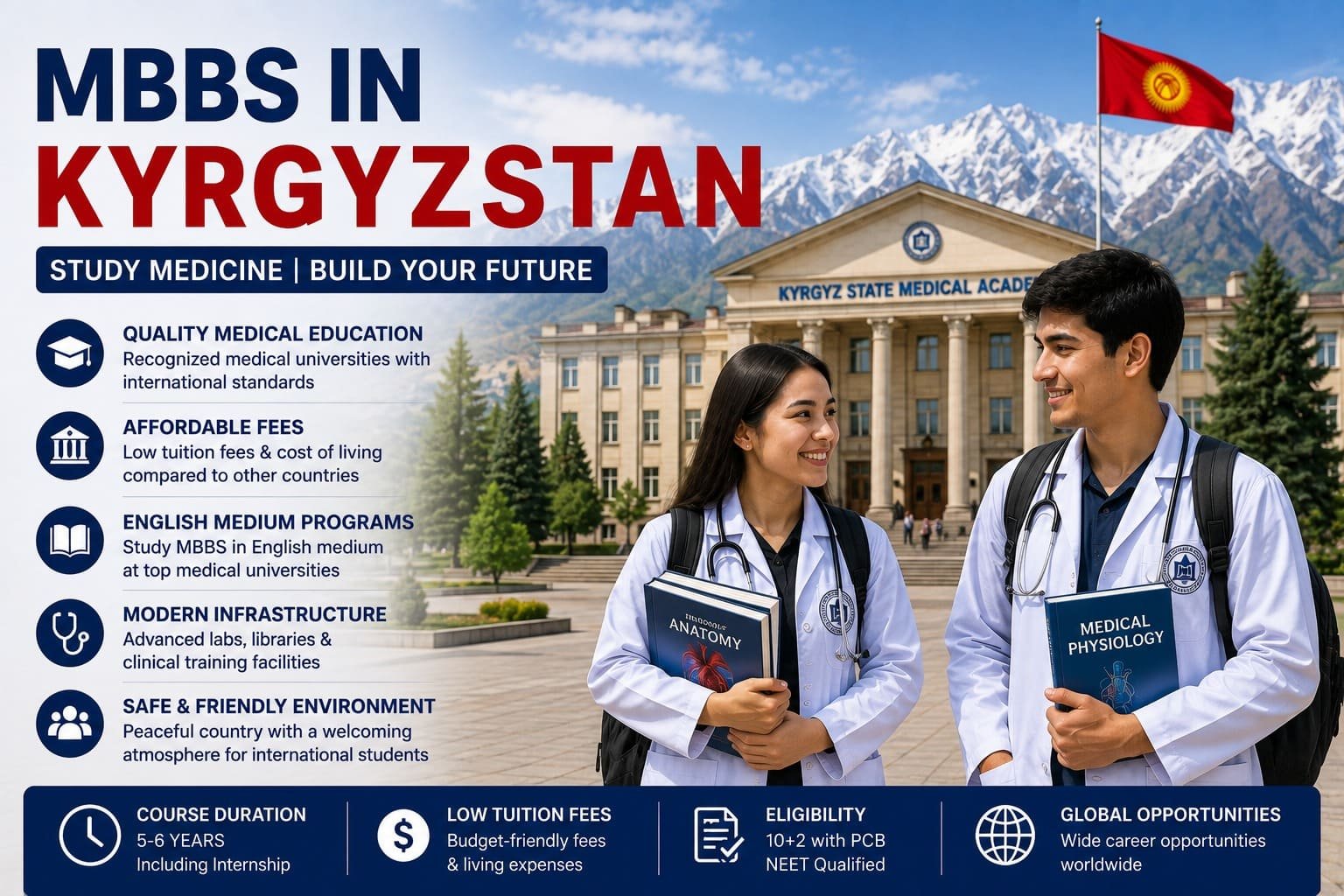
MBBS in Kyrgyzstan 2026-27 is a popular choice for Indian students seeking affordable medical education abroad. Kyrgyzstan offers English-medium medical programs, experienced faculty, modern infrastructure, clinical exposure, and a multicultural student environment. Students can explore medical universities with comparatively affordable tuition fees and living costs. NEET qualification is mandatory for Indian students, and candidates should verify the university's current recognition and compliance with applicable NMC regulations before admission
MBBS in Kyrgyzstan 2026–27: Fees, Eligibility, Top Medical Universities, Admission & Complete Guide for Indian Students
Introduction
MBBS in Kyrgyzstan has become one of the most popular options for Indian students who wish to pursue an affordable and internationally recognized medical degree. Over the last decade, thousands of Indian students have enrolled in Kyrgyz medical universities due to their reasonable tuition fees, English-medium education, globally accepted curriculum, and modern infrastructure.
Kyrgyzstan, officially known as the Kyrgyz Republic, is a beautiful Central Asian country known for its high-quality medical education system and student-friendly environment. The country is home to several government-recognized medical universities that attract students from India, Nepal, Pakistan, Bangladesh, Sri Lanka, and many African countries.
The MBBS program in Kyrgyzstan is designed according to international medical education standards. Most universities offer a 6-year medical program, which includes 5 years of academic study followed by 1 year of compulsory clinical internship. The curriculum focuses on theoretical knowledge, laboratory training, practical sessions, clinical rotations, and hospital-based learning, enabling students to develop strong medical skills.
One of the biggest advantages of studying MBBS in Kyrgyzstan is its affordability. Compared to private medical colleges in India, students can complete their entire medical education at a significantly lower cost while receiving quality education from experienced professors and doctors.
Medical universities in Kyrgyzstan are recognized by organizations such as the World Health Organization (WHO) and listed in international medical directories. Indian students should also ensure that the university they choose complies with the latest National Medical Commission (NMC) regulations and the recent advisory issued by the Embassy of India in Bishkek before taking admission.
Apart from affordable education, students enjoy modern laboratories, digital classrooms, simulation centers, university hospitals, separate hostel facilities for boys and girls, Indian mess facilities, sports complexes, libraries, and multicultural campuses. Many universities also organize research activities, medical conferences, and clinical workshops to enhance practical learning.
Why Choose MBBS in Kyrgyzstan?
Kyrgyzstan has become one of the most preferred destinations for Indian medical aspirants due to its quality education, affordable fee structure, and internationally recognized medical degrees. Every year, thousands of students choose Kyrgyzstan because of its excellent academic environment and comparatively lower cost of living.
Some of the major reasons why students prefer MBBS in Kyrgyzstan include:
Affordable Tuition Fees
Medical education in Kyrgyzstan is much cheaper than private medical colleges in India. Students can complete their MBBS at approximately one-third of the cost of many private Indian institutions.
No Donation or Capitation Fee
Universities in Kyrgyzstan offer direct admission based on eligibility criteria. Students are generally not required to pay any donation or capitation fee.
English-Medium Education
Most universities offer complete MBBS programs in English for international students. However, students are also taught basic Russian or Kyrgyz language to communicate effectively with local patients during clinical training.
International Recognition
Many medical universities are recognized by organizations such as WHO and follow international standards. Indian students should always verify compliance with the latest NMC regulations before admission.
Experienced Faculty
Medical universities employ highly qualified professors, researchers, and experienced clinicians who provide both theoretical and practical medical education.
Modern Infrastructure
Students receive education in modern classrooms equipped with:
- Digital learning systems
- Smart classrooms
- Anatomy museums
- Simulation laboratories
- Research laboratories
- Clinical skill centers
- University hospitals
Clinical Exposure
Students begin clinical rotations in affiliated hospitals after completing their pre-clinical years, allowing them to gain real patient exposure under experienced doctors.
Affordable Living Expenses
Monthly living expenses generally range between USD 100–200, depending on lifestyle and city.
Indian Community
Thousands of Indian students already study in Kyrgyzstan, making it easier for newcomers to adjust to the environment.
Indian Food Availability
Most university hostels provide Indian mess facilities, including vegetarian and non-vegetarian meals.
Safe Environment
Kyrgyzstan is generally considered a student-friendly country with dedicated international student support departments in many universities.
MBBS in Kyrgyzstan 2026–27 Highlights
| Particular | Details |
|---|---|
| Course Name | MBBS / MD (Equivalent) |
| Duration | 6 Years (5 Academic + 1 Internship) |
| Intake | September / October |
| Medium of Teaching | English |
| Eligibility | 50% PCB (General), 40% (Reserved Categories) |
| NEET | Mandatory for Indian Students |
| IELTS/TOEFL | Not Required |
| Annual Tuition Fee | USD 3,500–5,000 (varies by university) |
| Hostel Fee | USD 500–1,000 per year |
| Living Cost | USD 100–200 per month |
| Currency | Kyrgyzstani Som (KGS) |
| Capital | Bishkek |
| Recognition | WHO, NMC-compliant universities, WDOMS and other recognized bodies (subject to university status) |
Quick Facts About Kyrgyzstan
| Particular | Information |
|---|---|
| Country | Kyrgyz Republic |
| Capital City | Bishkek |
| Official Languages | Kyrgyz, Russian |
| Population | Around 7 million |
| Currency | Kyrgyzstani Som (KGS) |
| Climate | Continental |
| Time Difference | Around 30 minutes behind IST (varies seasonally) |
| Major Cities | Bishkek, Osh, Jalal-Abad, Kant |
| International Airport | Manas International Airport |
Is MBBS in Kyrgyzstan Worth It in 2026?
Yes, MBBS in Kyrgyzstan can be a good option for Indian students who:
- Have qualified NEET.
- Want an affordable alternative to expensive private medical colleges.
- Are willing to complete the full course and internship abroad as required.
- Carefully choose a university that complies with current NMC regulations and offers good clinical exposure.
Eligibility Criteria for MBBS in Kyrgyzstan 2026–27
Indian students planning to study MBBS in Kyrgyzstan must satisfy both the eligibility requirements applicable to foreign medical education in India and the admission requirements of the selected Kyrgyz university.
Academic Qualification
Students should have completed Class 12 or an equivalent examination with Physics, Chemistry and Biology/Biotechnology and English as required under the applicable eligibility rules.
For Indian students, the commonly applicable minimum PCB requirement is:
- 50% aggregate in PCB for General category students
- Relaxation may apply to reserved categories according to the applicable Indian rules.
- The student must have passed Class 12 from a recognized board.
- The student must satisfy the age requirement applicable to the admission year.
NEET Qualification
NEET-UG qualification is mandatory for Indian citizens/OCI candidates seeking a primary medical qualification abroad. The Embassy of India in Kyrgyzstan also specifically advises prospective Indian medical students to meet the NEET requirement.
Therefore, students should not consider admission to a Kyrgyz medical university without first checking their NEET eligibility.
Age Requirement
The applicant should generally have attained 17 years of age by 31 December of the year of admission, subject to the applicable rules for the relevant admission cycle.
Is IELTS Required?
For most English-medium medical programs in Kyrgyzstan, IELTS or TOEFL is generally not the primary admission requirement. However, individual universities may prescribe their own English-language requirements, so students should verify the requirements directly with the university before applying.
NMC Requirements for MBBS in Kyrgyzstan
This is one of the most important sections for Indian students.
The National Medical Commission (NMC) has specific regulations governing foreign medical graduates. The NMC's 2026 advisory reminds students that foreign medical education must comply with the applicable standards before they choose a university.
Students should verify all of the following before paying fees:
Minimum Medical Education Duration
The applicable FMGL framework requires at least 54 months of medical education, followed by the prescribed internship requirements. The academic training should not be artificially shortened.
Entire Course From a Properly Recognized Institution
Students should complete their medical education from an institution that is properly recognized and authorized to award the relevant medical qualification in Kyrgyzstan.
English-Medium Requirement
Indian students should verify that the medical course meets the applicable NMC requirements regarding the medium of instruction.
Clinical Training
Clinical training is an essential component of the medical program. Students should confirm:
- Where clinical training takes place
- Which hospitals are affiliated with the university
- Whether sufficient patient exposure is available
- Whether clinical training is conducted in person
- Whether the university provides the required practical training
Internship
The internship arrangement should be checked carefully before admission. Students should not rely solely on an agent's statement that an internship is "included."
The NMC's 2026 advisory specifically stresses checking foreign institutions and the actual structure of the medical education before admission.
Important 2026 Advisory for Indian Students in Kyrgyzstan
The Embassy of India in Bishkek published an advisory updated on 23 April 2026 for Indian students wishing to study medicine in Kyrgyzstan. The advisory specifically recommends that prospective students travel to Kyrgyzstan for medical studies on a Student Visa and not another category of visa.
This is an important point for students and parents.
Students should verify:
- University authorization and accreditation.
- Medical program duration.
- Medium of instruction.
- Clinical training arrangements.
- Internship structure.
- Student visa category.
- Accommodation arrangements.
- Fee structure directly with the university.
- Whether the qualification satisfies the current NMC requirements.
- Whether the university has any current regulatory restrictions or advisories.
Do not choose a university only because an agent advertises it as "NMC approved."
The NMC itself should be treated as the primary regulatory source for Indian eligibility, while the Kyrgyz authorities and the university should be checked for local authorization.
Admission Process for MBBS in Kyrgyzstan
Admission to Kyrgyzstan medical universities is comparatively straightforward, but Indian students should complete every step carefully.
Step 1: Qualify NEET
The first step for an Indian student is to qualify NEET-UG according to the applicable rules.
Step 2: Select a Medical University
Compare universities based on:
- Accreditation
- NMC compliance
- Course duration
- Medium of instruction
- Clinical exposure
- Hospital facilities
- Tuition fees
- Hostel facilities
- Indian student support
- Location
- University reputation
Step 3: Submit the Application
The student submits the university application along with the required academic and identification documents.
Step 4: Document Verification
The university checks the student's:
- Academic qualifications
- NEET qualification
- Passport
- Other required documents
Step 5: Receive Admission/Offer Letter
After successful verification, the university issues the relevant admission or offer document.
Step 6: Pay the Required University Fees
Students should make payments only through the official university-approved process and retain receipts for every transaction.
Step 7: Visa Process
After receiving the required university documentation, the student proceeds with the student visa process.
The Embassy of India in Bishkek specifically advises Indian students coming to Kyrgyzstan for medical studies to use the Student Visa category.
Step 8: Travel to Kyrgyzstan
After obtaining the required visa and completing university formalities, students can travel to Kyrgyzstan.
Step 9: University Registration
After reaching Kyrgyzstan, students complete:
- University registration
- Hostel registration
- Medical formalities
- Immigration-related formalities
- Academic enrollment
Step 10: Start Classes
Students begin their academic program according to the university's academic calendar.
Documents Required for MBBS in Kyrgyzstan
Students should keep both original documents and sufficient scanned copies.
Academic Documents
- Class 10 marksheet
- Class 10 certificate
- Class 12 marksheet
- Class 12 certificate
- NEET scorecard
- NEET qualification document, where applicable
Identity Documents
- Valid passport
- Passport-size photographs
- Aadhaar/PAN or other identity document, if required
- Birth certificate, where required
University Documents
- Application form
- Admission/offer letter
- Fee payment receipt
- University invitation/supporting visa document, where applicable
Medical & Travel Documents
- Medical fitness certificate
- Required medical test reports
- Health/travel insurance, where applicable
- Vaccination records, if required
Financial Documents
Depending on the university and visa process:
- Bank statement
- Sponsorship/financial undertaking
- Parent/guardian documents
Students should always obtain the final document checklist from their selected university and the relevant visa authorities because requirements can change.
MBBS Fee Structure in Kyrgyzstan 2026–27
One of the main reasons students consider Kyrgyzstan is its relatively affordable medical education.
However, there is no single MBBS fee applicable to every university. Tuition varies according to the university, program, campus, accommodation and other charges.
A reasonable planning range for many programs is approximately USD 3,500–5,000 per academic year, but students should confirm the exact 2026–27 fee directly with the university before making payment.
Estimated Cost Components
| Expense | Approximate Range |
|---|---|
| Tuition Fee | USD 3,500–5,000/year |
| Hostel | Depends on university |
| Food | Depends on lifestyle |
| Insurance | University/plan dependent |
| Visa | As applicable |
| Flight | Varies by season |
| Personal Expenses | Depends on lifestyle |
Important Fee Warning
Do not publish a fixed INR fee on a website as if it is guaranteed for the entire six-year course.
Foreign university fees can change because of:
- Currency exchange rates
- University fee revisions
- Hostel changes
- Additional academic charges
- Insurance
- Administrative expenses
Therefore, the final fee should always be confirmed before admission.
Cost of Living in Kyrgyzstan
Kyrgyzstan generally offers a lower cost of living than many European destinations.
A student's monthly expenditure depends heavily on accommodation, food, transportation and personal lifestyle.
Major Expenses
Food
Students can reduce expenses by using university cafeterias or hostel mess facilities. Indian food is also available in several student areas and university facilities.
Accommodation
University hostels are generally cheaper than private apartments.
Transportation
Public transportation is comparatively affordable, particularly in major cities such as Bishkek and Osh.
Personal Expenses
Students should budget separately for:
- Mobile recharge
- Internet
- Clothing
- Medicines
- Entertainment
- Local travel
- Study materials
For planning purposes, many education providers quote approximately USD 100–200 per month, but actual spending can vary substantially.
Duration of MBBS in Kyrgyzstan
The duration of medical education is an important factor for Indian students.
A standard medical pathway generally involves:
Academic Medical Education
The academic component should meet the applicable minimum duration requirements.
Clinical Training
Students receive clinical exposure through hospitals and affiliated clinical departments.
Internship
The internship is an essential component of medical education and should be completed according to the applicable university, Kyrgyz regulatory and NMC requirements.
Therefore, students should think of the program as a full medical education pathway rather than simply a five-year classroom course.
Medium of Instruction
English-medium programs are available for international students in Kyrgyzstan.
However, students should understand an important distinction:
Studying medicine in English does not mean that students will never encounter Russian or Kyrgyz.
During clinical training, communication with local patients can require knowledge of the local language.
Therefore, many universities introduce basic:
- Russian
- Kyrgyz
- Medical terminology
- Patient communication
This can be particularly useful during hospital rotations.
Learning basic local language skills can improve:
- Patient interaction
- Clinical history taking
- Communication with hospital staff
- Daily life
- Social adjustment
MBBS Syllabus in Kyrgyzstan
The exact curriculum varies between universities, but medical education generally progresses from basic sciences to clinical subjects.
First Year
Students generally study foundational medical subjects such as:
- Anatomy
- Histology
- Biology
- Medical chemistry
- Physics
- Physiology
- Introduction to medicine
Second Year
The focus shifts towards:
- Anatomy
- Physiology
- Biochemistry
- Histology
- Microbiology
- Medical psychology
Third Year
Students begin studying important disease-related disciplines:
- Pathology
- Pharmacology
- Microbiology
- Immunology
- General pathology
- General pharmacology
Fourth Year
Clinical subjects become increasingly important:
- Internal Medicine
- General Surgery
- Pediatrics
- ENT
- Neurology
- Oncology
- Radiology
Fifth Year
Students study advanced clinical disciplines such as:
- Obstetrics & Gynecology
- Pediatrics
- Ophthalmology
- Orthopedics
- Surgery
- Internal Medicine
- Forensic Medicine
- Toxicology
- Infectious Diseases
Final Clinical/Internship Stage
Students receive supervised practical exposure in areas such as:
- Medicine
- Surgery
- Pediatrics
- Obstetrics & Gynecology
- Emergency care
- Primary care
The exact semester-wise structure should be obtained from the university because course plans can differ.
Clinical Exposure in Kyrgyzstan
Clinical exposure is one of the most important factors students should consider before admission.
A good medical university should provide students with access to:
- Teaching hospitals
- Clinical departments
- Outpatient departments
- Inpatient wards
- Emergency departments
- Diagnostic laboratories
- Surgical units
- Pediatrics departments
- Obstetrics and gynecology departments
Students should not judge a university solely by its classroom infrastructure.
Before admission, ask the university:
Which hospitals will Indian students attend for clinical training?
Also ask:
How many months of clinical training are included?
Is the training conducted in person?
What is the approximate patient load?
These questions can help students make a more informed decision.
Top Medical Universities in Kyrgyzstan
Several Kyrgyz institutions are known for medical education. Examples include:
International School of Medicine, Bishkek
The International School of Medicine is located in Bishkek and offers medical education to international students.
It is particularly known for its international student population and English-medium medical education.
Students considering this institution should verify its current program structure, accreditation and compliance status for their admission year.
Kyrgyz State Medical Academy
Located in Bishkek, the institution is one of the country's established medical education institutions.
It has a long history of medical training and offers education across different medical disciplines.
Kyrgyz Russian Slavic University
Kyrgyz Russian Slavic University is based in Bishkek and is another prominent higher education institution offering medical education.
Students should independently verify the current structure of its medical program and admission requirements.
Osh State University
Osh State University is located in Osh and has a significant international student population.
Its medical faculty is one of the institutions considered by international medical aspirants.
Jalal-Abad State University
Jalal-Abad State University is located in Jalal-Abad and provides medical education to domestic and international students.
Students should verify the exact current medical program, clinical training arrangements and regulatory status before admission.
Asian Medical Institute
Asian Medical Institute is another institution that has historically attracted international students seeking medical education in Kyrgyzstan.
As with every foreign medical university, students should verify the institution's current authorization, accreditation, course structure and NMC compliance rather than relying on older promotional information.
How to Choose the Best Medical University in Kyrgyzstan
There is no single university that is automatically the "best" for every student.
Instead, compare universities using these factors:
1. NMC Compliance
This should be the first consideration for an Indian student planning to return to India.
2. University Recognition
Check recognition and authorization from the relevant Kyrgyz authorities.
3. Course Duration
Make sure the program satisfies the applicable NMC duration requirements.
4. Clinical Training
Check affiliated hospitals and actual clinical exposure.
5. Medium of Instruction
Confirm that the course meets the applicable English-medium requirements.
6. Internship
Understand exactly where and how the internship is conducted.
7. Total Cost
Do not compare only tuition fees.
Calculate:
Tuition + Hostel + Food + Insurance + Visa + Travel + Personal Expenses
8. Student Support
Check whether the university has:
- International student office
- Indian student support
- Hostel management
- Visa support
- Airport assistance
9. Location
Bishkek, Osh and other cities offer different living environments and costs.
10. Reputation
Speak with current students and verify information through official university sources.
Advantages of Studying MBBS in Kyrgyzstan
Affordable Medical Education
The cost is generally lower than many private medical colleges in India.
English-Medium Programs
International students can study medicine through English-medium programs.
International Student Community
Students from different countries create a multicultural learning environment.
No Donation-Based Admission
Students generally apply based on academic eligibility and university admission requirements.
Lower Living Expenses
Daily expenses can be relatively affordable compared with many Western countries.
Clinical Exposure
Students can gain practical experience through hospital-based training.
Indian Food
Indian food options are available in many student areas and university hostels.
Cultural Exposure
Students experience a new country and interact with people from different cultural backgrounds.
Disadvantages of MBBS in Kyrgyzstan
Studying medicine abroad also comes with challenges.
Cold Climate
Kyrgyzstan experiences cold winters, particularly compared with most parts of India.
Language Barrier
Although medical education may be in English, local patient communication can require Russian or Kyrgyz.
Homesickness
Students may initially find it difficult to live away from their families.
Different Medical System
The healthcare system and hospital practices may differ from India.
Licensing Requirements
Completing an overseas medical degree does not automatically give an Indian student the right to practice medicine in India.
Graduates must meet the applicable Indian licensing and registration requirements.
University Selection Risk
The biggest risk is choosing a university without properly verifying its current status.
Is MBBS in Kyrgyzstan Valid in India?
This question is extremely important.
An MBBS/primary medical qualification obtained abroad does not automatically authorize a graduate to practice medicine in India.
Indian students must satisfy the applicable NMC Foreign Medical Graduate regulations and licensing requirements.
The NMC maintains specific information for Indian students studying medicine abroad and foreign medical graduates.
Therefore, before admission, students should verify:
- NEET qualification
- Recognized foreign medical institution
- Required course duration
- English-medium education requirements
- Clinical training
- Internship requirements
- Licensing examination requirements
- Indian registration requirements
Do not rely on statements such as "WHO approved, therefore automatically valid in India."
WHO recognition alone is not the same thing as eligibility for Indian medical registration.
FMGE/NExT After MBBS in Kyrgyzstan
Indian students returning after completing a foreign medical degree must follow the licensing pathway applicable at that time.
The regulatory framework has been evolving, and students should not assume that an older article describing only the FMGE pathway will necessarily apply when they graduate.
The NMC's current rules and official notifications should be checked when the student reaches the licensing stage.
Therefore, a student joining in 2026–27 should plan their education around current NMC requirements but also understand that licensing rules may be updated during the six-year period.
Student Life in Kyrgyzstan
Kyrgyzstan offers a different lifestyle from India, but international students generally find several familiar facilities.
Accommodation
Most universities offer student hostels.
Facilities can include:
- Shared rooms
- Study areas
- Common kitchens
- Wi-Fi
- Security
- Laundry facilities
Facilities vary by university.
Food
Indian students can find Indian food in several university areas and cities.
Students can also cook or purchase groceries locally.
Transportation
Public transportation is available in major cities.
Students should familiarize themselves with local transport systems after arrival.
Safety
Students should follow university rules and local laws, avoid unnecessary risks and maintain emergency contacts.
The Embassy of India in Bishkek provides advisories specifically for Indian students in Kyrgyzstan, making it an important source of information for students and parents.
Weather in Kyrgyzstan
The climate is significantly colder than most parts of India.
Summer
Summers can be warm, especially during the daytime.
Winter
Winters can be cold, with temperatures falling below freezing in many areas.
Students should carry:
- Heavy winter jacket
- Thermal clothing
- Gloves
- Woolen socks
- Winter shoes
- Cap
- Moisturizer
Indian students coming from warmer regions may need some time to adapt.
Scholarship Opportunities
Scholarship availability depends on the university and the student's academic performance.
Some universities may offer scholarships or discounts according to their institutional policies.
Students should ask the university:
- Is a scholarship available for international students?
- Is it available from the first year?
- Is it merit-based?
- What percentage of tuition can be reduced?
- What academic performance must be maintained?
Students should never assume that a scholarship is guaranteed unless it is formally mentioned in the university's documentation.
Part-Time Work During MBBS
Medical education is demanding, and students should prioritize their studies.
Whether an international student can work part-time depends on:
- Kyrgyz immigration rules
- Student visa conditions
- University regulations
- Any required work authorization
Students should not start employment simply because an agent says it is allowed. They should obtain confirmation from the relevant authorities before working.
MBBS in Kyrgyzstan vs MBBS in India
| Factor | Kyrgyzstan | India |
|---|---|---|
| Admission | University/foreign admission route | NEET-based |
| Competition | Lower compared with Indian government seats | Very high |
| Tuition | Generally affordable | Government colleges low; private colleges can be high |
| Language | English programs available | English + local languages |
| Duration | Generally 5+1/internship structure | Typically 5.5 years including internship |
| Living Abroad | Required | Not required |
| Cultural Adjustment | Required | Easier for Indian students |
| Licensing | Indian students must satisfy NMC requirements | Indian medical registration pathway |
MBBS in Kyrgyzstan vs Other MBBS Abroad Destinations
Students commonly compare Kyrgyzstan with:
- Russia
- Kazakhstan
- Uzbekistan
- Georgia
- Egypt
- Bangladesh
- Nepal
- Philippines
The right destination depends on the student's:
- Budget
- NEET score
- Academic profile
- Preferred climate
- Language preference
- Clinical exposure requirements
- Career plans
- NMC compliance
A university with a slightly higher fee but stronger clinical training may be a better choice than a very cheap university with limited patient exposure.
Important Things Parents Should Check
Parents should not finalize admission based only on advertisements.
Before paying fees, ask for written confirmation regarding:
University
- Full legal name
- Address
- Accreditation
- Recognition
- Medical program authorization
Course
- Duration
- Curriculum
- Medium
- Clinical training
- Internship
Fees
- Tuition
- Hostel
- Insurance
- Other charges
- Refund policy
Accommodation
- Hostel address
- Room capacity
- Food arrangements
- Security
- Distance from university
Student Support
- Indian student coordinator
- Visa support
- Airport pickup
- Emergency contact
Red Flags While Choosing a Kyrgyzstan Medical University
Be cautious if an agent promises:
- "100% NMC guarantee"
- "No NEET required"
- "MBBS completed in 4 years"
- "No internship required"
- "You can study online from India"
- "No need to attend classes"
- "Guaranteed Indian medical license"
- "Guaranteed FMGE/NExT pass"
- "Pay cash without university receipt"
These claims should be independently verified.
The NMC's 2026 advisory makes verification of foreign medical institutions particularly important.
MBBS in Kyrgyzstan Admission Timeline 2026–27
The exact dates vary by university.
A general planning timeline can look like this:
| Stage | Approximate Period |
|---|---|
| NEET Qualification | As per NTA schedule |
| University Research | May–June |
| Applications | May–August |
| Admission/Offer | After document verification |
| Visa Documentation | After university documentation |
| Travel | Before commencement of classes |
| Registration | On arrival |
| Classes | As per university academic calendar |
Important: Do not publish a universal "last date of 1 August" for every Kyrgyz university. Each institution can have its own deadline.
Career Opportunities After MBBS in Kyrgyzstan
After completing medical education, graduates may pursue different career pathways depending on their country of registration and licensing.
Return to India
Indian graduates must satisfy the applicable NMC requirements and licensing pathway.
Postgraduate Education
Graduates can pursue postgraduate medical education after meeting the eligibility requirements of the country where they intend to study.
Medical Practice Abroad
Graduates wishing to practice in another country must satisfy that country's medical licensing requirements.
Research
Medical graduates can pursue:
- Clinical research
- Public health
- Medical research
- Academic medicine
- Healthcare administration
Is Kyrgyzstan Good for Indian Students?
Kyrgyzstan can be a suitable option for Indian students who want:
- Affordable medical education
- English-medium medical studies
- International exposure
- A multicultural environment
- Lower living expenses
However, the university matters more than the country name alone.
A student should select a university only after checking its current regulatory status, course structure, clinical training, internship arrangements and compatibility with the latest NMC requirements.
Final Checklist Before Admission
FAQs – MBBS in Kyrgyzstan 2026–27
1. Is NEET mandatory for MBBS in Kyrgyzstan?
Yes. Indian citizens/OCIs seeking a primary medical qualification abroad must meet the applicable NEET requirement.
2. What is the duration of MBBS in Kyrgyzstan?
The medical education pathway generally includes academic study followed by internship. Students should verify the exact structure of their chosen university and ensure it meets current NMC requirements.
3. Is MBBS in Kyrgyzstan affordable?
Yes. Kyrgyzstan is considered a relatively affordable destination for medical education, although the total cost varies significantly by university and lifestyle.
4. Is MBBS taught in English?
English-medium medical programs are available for international students. Students may also need to learn Russian or Kyrgyz for communication with local patients.
5. Can Indian students practice medicine in India after graduating from Kyrgyzstan?
A foreign medical degree does not automatically provide an Indian medical license. Graduates must satisfy the applicable NMC regulations, licensing examination requirements and registration conditions.
6. Is IELTS required?
Generally, IELTS is not a universal requirement for admission to English-medium MBBS programs in Kyrgyzstan, but individual university requirements should be checked.
7. What is the approximate MBBS fee in Kyrgyzstan?
Many universities fall within an approximate range of USD 3,500–5,000 per year, but the exact 2026–27 fee must be confirmed directly with the university.
8. Is Indian food available?
Indian food is available in several universities, hostels and student areas, although facilities differ from one institution to another.
9. Is Kyrgyzstan safe for Indian students?
Students should follow university safety guidelines and local laws. The Embassy of India in Bishkek provides country-specific advisories and is an important official source for Indian students.
10. Can students work part-time?
International students should verify whether employment is permitted under their student visa and Kyrgyz immigration rules before accepting any job.
11. What is the best medical university in Kyrgyzstan?
There is no universal "best" university. Indian students should compare current accreditation, NMC compliance, clinical exposure, teaching medium, internship structure, fees and student support.
12. What visa should Indian medical students use?
The Embassy of India in Bishkek advises prospective Indian medical students to come to Kyrgyzstan on a Student Visa and not another visa category.
Conclusion
MBBS in Kyrgyzstan 2026–27 can be an affordable pathway for Indian students seeking medical education outside India. The country offers English-medium programs, relatively moderate tuition fees, international student communities and opportunities for clinical learning.
However, affordability should not be the only criterion when selecting a medical university. The most important step is to verify the current recognition, course duration, medium of instruction, clinical training, internship structure and NMC compliance of the specific university before paying any admission fee.
The NMC's 2026 advisory and the Embassy of India in Bishkek's updated advisory make it especially important for students to conduct proper due diligence before travelling to Kyrgyzstan.
For a student joining in 2026–27, the safest approach is to select the university based on regulatory compliance and quality of medical education first, and fee second.

NEET 2026 Counselling Latest Updates: Registration, Dates & Admission Process
Sat Jun 2026
NEET 2026 counselling is one of the most important stages for students seeking admission to MBBS, BDS, AYUSH, and other...

CAT 2026 Latest Updates: Exam Date, Registration & MBA Admission Guide
Sat Jun 2026
CAT 2026 is one of India's most competitive MBA entrance exams, conducted for admission to IIMs and other top business...

CLAT 2026 Latest Updates: Exam Date, Registration & Law Admission Guide
Sat Jun 2026
CLAT 2026 is the national-level law entrance examination for admission to undergraduate and postgraduate law programmes offered by participating National...

CUET(UG) 2026 Latest Updates: Exam Date, Registration & Admission Guide
Sat Jun 2026
CUET 2026 is one of India's most important undergraduate entrance examinations for admission to Central Universities and other participating institutions....

JEE Advanced 2026 Latest Updates: Exam Date, Result & IIT Admission Guide
Sat Jun 2026
JEE Advanced 2026 is the gateway to admission into the Indian Institutes of Technology (IITs). Candidates who qualify JEE Main...

NATA 2026 Latest Updates: Exam Date, Registration & B.Arch Admission Guide
Sat Jun 2026
NATA 2026 is a national-level entrance examination conducted for admission to Bachelor of Architecture (B.Arch) programmes offered by participating institutions...

NEET PG 2026 Registration Started: Apply Online, Important Dates & Complete Guide
Mon Jul 2026
NEET PG 2026 registration has officially begun. Eligible MBBS graduates can now submit their online application through the official NBEMS...
NEET UG & NEET PG 2026: Latest Changes Every Medical Aspirant Should Know
Mon Jul 2026
Several important changes have been introduced for NEET UG and NEET PG 2026. From revised exam timings and improved exam-day...

Complete Guide to Institutes of National Importance in India (2026)
Sat Jul 2026
Institutes of National Importance in India (2026): Complete Guide India is home to several prestigious educational institutions that have been...
List of Top IITs in India
Sat Jul 2026
Introduction The Indian Institutes of Technology (IITs) are India's premier engineering institutions, renowned for academic excellence, cutting-edge research, innovation, and...
List of IIMs in India (2026): Complete List, Courses, Fees, CAT Admission & Placements
Sat Jul 2026
Introduction The Indian Institutes of Management (IIMs) are India's premier management institutions, known for world-class business education, leadership development, and...
List of NITs in India (2026): Complete List, Rankings, Courses, Fees & JEE Main Admission
Sat Jul 2026
NITs in India 2026 – Short Overview The National Institutes of Technology (NITs) are among the leading public technical institutions...
List of IIITs in India (2026): Complete List, Courses, Fees & JEE Main Admission
Sat Jul 2026
Introduction The Indian Institutes of Information Technology (IIITs) are premier technical institutions specializing in Computer Science, Information Technology, Artificial Intelligence,...
Difference Between IIT, NIT, IIIT & IIM: Which One Should You Choose in 2026?
Sat Jul 2026
Introduction Choosing between an IIT, NIT, IIIT, or IIM is one of the most important decisions for students planning their...

How to Get Admission into Institutes of National Importance (2026): Complete Admission Guide
Sat Jul 2026
Introduction Institutes of National Importance (INIs) are among India's most prestigious higher education institutions, recognized by the Government of India...
List of AIIMS in India (2026): Complete List, Courses, Fees, MBBS Seats & NEET Admission
Sat Jul 2026
Introduction The All India Institute of Medical Sciences (AIIMS) is India's most prestigious group of medical institutions, recognized as Institutes...

How to Choose the Right College After 12th: Complete Admission & Career Guide
Sat Jul 2026
Choosing the right college after Class 12 is one of the most important decisions for your academic and professional future....
College Admission Documents Required in India (2026): Complete Checklist for Students
Sat Jul 2026
Applying for college admission in India requires more than just meeting the eligibility criteria. Students must also submit the correct...
College Admission Documents Required in India (2026): Complete Checklist for Students
Sat Jul 2026
Applying for college admission in India requires more than just meeting the eligibility criteria. Students must also submit the correct...
How to Check if a College is UGC, AICTE or NMC Approved: Step-by-Step Verification Guide
Sat Jul 2026
Before taking admission to any college or university, it is essential to verify whether the institution is approved by the...
NAAC Grade, NIRF Ranking & College Approvals Explained: How to Choose a Recognized College
Sat Jul 2026
When selecting a college after Class 12, many students come across terms like NAAC Grade, NIRF Ranking, UGC Approval, AICTE...

Re-NEET UG 2026 Result Out: Scorecard, Cut-Off, Counselling, Career Options & MBBS Abroad Guide
Sat Jul 2026
The Re-NEET UG 2026 Result has been officially announced by the National Testing Agency (NTA), bringing relief and clarity to...
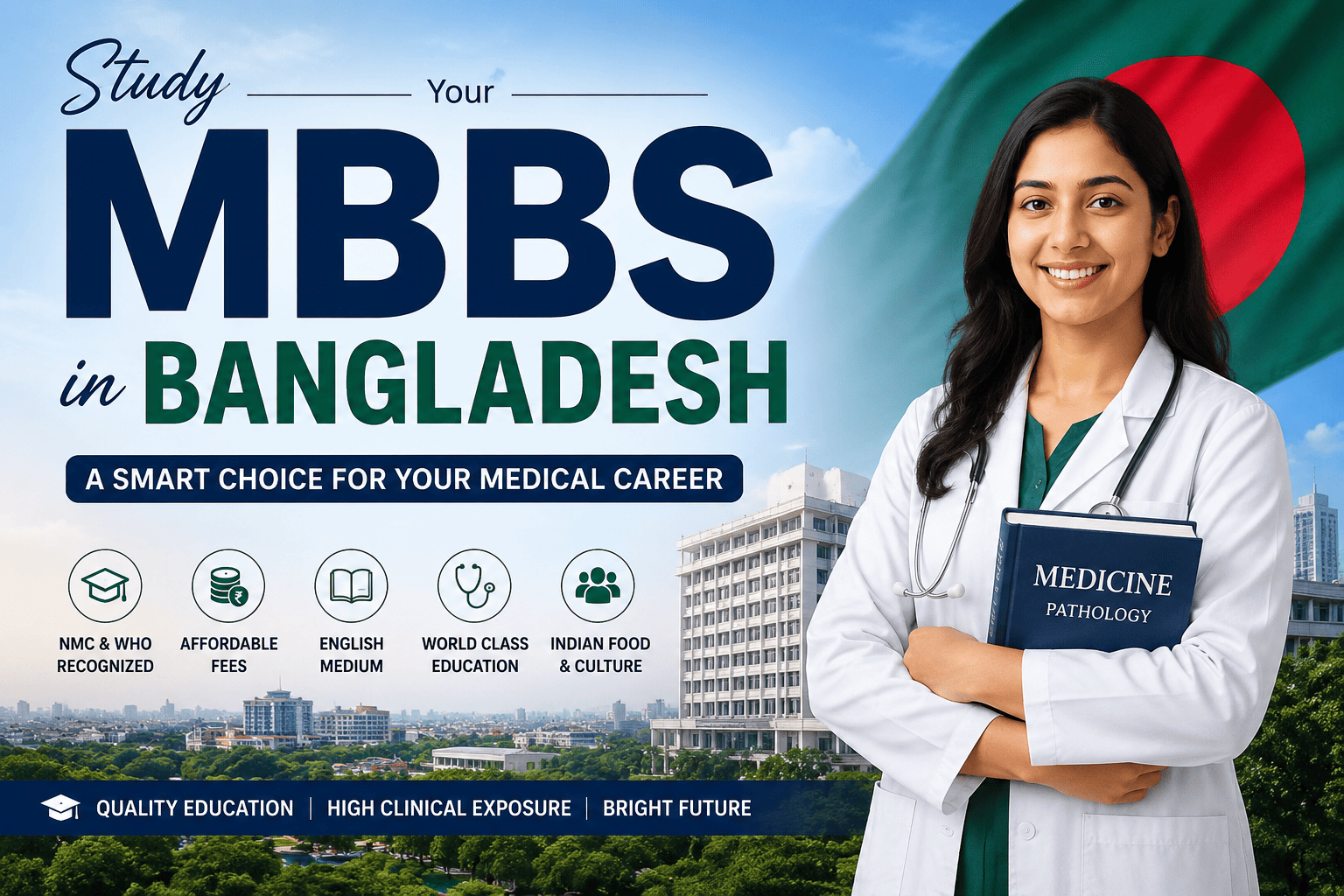
MBBS In Bangladesh
Tue Aug 2026
Bangladesh has become one of the most preferred destinations for Indian students who want to pursue MBBS abroad. Every year,...
MBBS In Nepal
Wed Aug 2026
Nepal is a very popular destination for Indian students seeking to study MBBS abroad. Indian students have long favoured studying...
MBBS In Egypt
Wed Aug 2026
MBBS in Egypt 2026 for Indian Students: Fees, Top Universities, Eligibility & Admission Process Study MBBS in Egypt 2026 is...
Top Female Medical Colleges in Bangladesh for Indian Students
Thu Aug 2026
Top Women’s Medical Colleges in Bangladesh for Indian Students For Indian female students planning to pursue MBBS abroad, Bangladesh can...

MBBS in Georgia for Indian Students 2026-27 – Fees, Eligibility, Admission & Universities
Thu Aug 2026
MBBS in Georgia for Indian Students 2026-27 – Fees, Eligibility, Admission & Universities MBBS in Georgia is an option for...
Study MBBS in Timor-Leste 2026-27: Fees, Eligibility & Admission
Thu Aug 2026
Gandaki Medical College Teaching Hospital and Research Centre (GMCTHRC) is a leading private medical college in Nepal, which was founded...
MBBS in Vietnam 2026-27 | Top NMC-Approved Universities, Fees
Fri Aug 2026
MBBS in Vietnam 2026-27 | Fees, Eligibility & Medical Universities for Indian Students MBBS in Vietnam is emerging as an...
MBBS in Mauritius
Fri Aug 2026
MBBS in Mauritius for Indian Students, Fees & Admission 2026 - 27 Mauritius is popularly known as the Republic of...
MBBS in China for Indian Students
Fri Aug 2026
MBBS in China is an option for Indian students looking to pursue medical education abroad at established universities with modern...

Study MBBS in Philippines for Indian Students
Fri Aug 2026
The Philippines is an increasingly considered destination for Indian students who want to pursue medical education abroad in an English-speaking...

MBBS in Russia
Fri Aug 2026
MBBS in Russia is a popular option for Indian students looking to pursue medical education abroad at a comparatively affordable...
MBBS In magnolia
Fri Aug 2026
Study MBBS in Mongolia 2026-27 MBBS in MongoliaMBBS in Mongolia can be your study abroad dream to study medicine affordably....
MBBS in Kazakhstan
Fri Aug 2026
MBBS in Kazakhstan for Indian Students MBBS in Kazakhstan is a popular option for Indian students looking to pursue medical...

MBBS in Central America 2026-27 | Fees & Eligibility
Fri Aug 2026
MBBS in Central America 2026-27 | Fees, Universities, Eligibility & Admission MBBS in Central America is becoming an option worth...
MBBS in Tajikistan 2026-27 | Fees, Universities & Eligibility
Fri Aug 2026
MBBS in Central America 2026-27 | Fees, Universities, Eligibility & Admission MBBS in Central America is an option for Indian...
MBBS in Uzbekistan
Sat Aug 2026
MBBS in Uzbekistan is an affordable option for Indian students seeking quality medical education abroad. Medical universities in Uzbekistan offer...
MBBS In Armenia
Sat Aug 2026
MBBS in Armenia 2026-27 MBBS in Armenia opens fantastic opportunities for medical aspirants worldwide. Choosing Armenia for the MBBS course...

Study MBBS in Belarus
Sat Aug 2026
MBBS in Belarus 2026–27 is an option for Indian students seeking medical education abroad. Belarus offers established medical universities, international...

FMGE 2026 Latest Update: Exam Date, Important Updates & What Aspirants Need to Know
Tue Sep 2026
FMGE 2026 aspirants, stay updated with the latest examination news, important announcements and upcoming FMGE dates. The FMGE December 2026...

NEET Qualified But No Government MBBS Seat? Here’s What You Can Do Next
Tue Sep 2026
Qualifying NEET is a major achievement, but it does not guarantee a government MBBS seat. If you haven't secured one,...