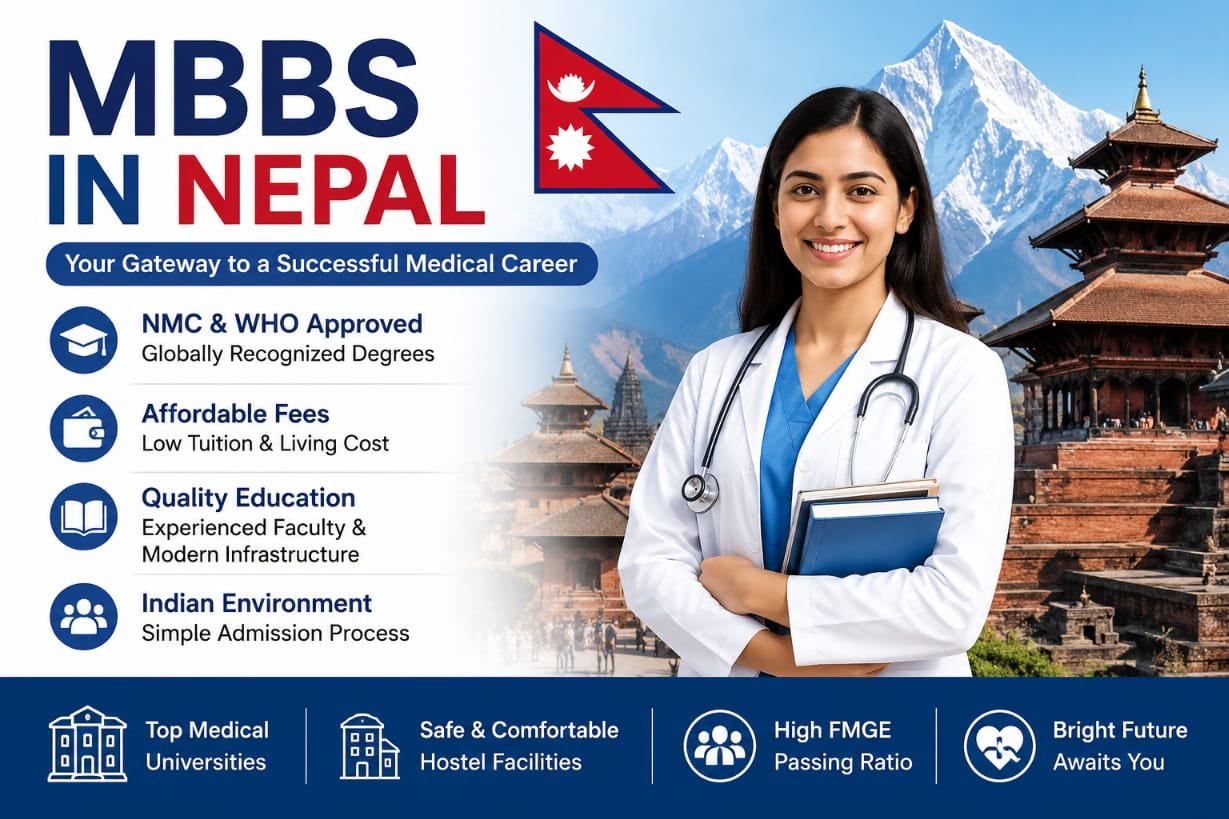
Nepal is a very popular destination for Indian students seeking to study MBBS abroad. Indian students have long favoured studying MBBS in Nepal for its numerous advantages. It is a neighbouring country of India, making travel easy and cheap. There are several similarities in study patterns, and the disease patterns are also similar. Nepal is also among the very few countries that appear to comply with NMC's Foreign Medical Graduate Licentiate Regulations (as per the notification by Nepal Medical Council).
Nepal's course structure, duration and MBBS syllabus are similar to those of India. Also, the disease pattern is similar, and the hospitals of the medical colleges in Nepal often see 1,000-2.500 patients daily. These are some of the main reasons the FMGE pass rate for students returning to India from Nepal is high. An updated. modern education system with a similar curriculum and strong exposure to practical training gives a clear edge to fresh pass-outs over pass-outs from other countries who have read and studied. Nepal is among the top 5 destinations for Indian students seeking an MBBS abroad.
MBBS in Nepal for Indian Students: Fees, Eligibility, Admission & NMC Rules
For many Indian students, getting an MBBS seat is not simply about clearing NEET. The bigger challenge is finding a medical college that fits their academic profile, budget and long-term career plans. This is why some students start looking at medical education outside India, including MBBS in Nepal for Indian students.
Nepal attracts attention because of its geographical proximity to India, familiar cultural environment and established medical education system. But choosing a foreign medical college requires more than looking at the tuition fee or hearing that a college is “popular among Indians.”
Before taking admission, students should understand the eligibility requirements, NEET rules, Nepal's admission process, total cost, university affiliation, clinical training and, most importantly, the requirements that apply if they eventually want to practise medicine in India.
For Indian students planning MBBS in Nepal, the National Medical Commission (NMC) framework is particularly important. The Foreign Medical Graduate Licentiate (FMGL) Regulations, 2021 prescribe conditions relating to the duration of study, medium of instruction, curriculum, clinical training and internship. NMC has also repeatedly advised Indian students to verify these requirements before joining a foreign medical institution.
This guide explains the major points students and parents should check before making that decision.
Table of Contents
Why MBBS Abroad?
Why MBBS in Nepal for Indian Students?
MBBS in Nepal – Course Overview
MBBS in Nepal Eligibility for Indian Students
NEET Eligibility for MBBS in Nepal
NMC Requirements for MBBS in Nepal
FMGL 2021 Explained
NExT and Foreign Medical Graduates
MBBS in Nepal Fees
Top Medical Colleges in Nepal for Indian Students
How to Choose the Right Medical College in Nepal
MBBS Admission Process in Nepal
Documents Required for Admission
MBBS in Nepal vs MBBS in India
Nepal vs Other MBBS Abroad Destinations
Is MBBS in Nepal Valid in India?
Advantages and Challenges of MBBS in Nepal
Career After MBBS in Nepal
CareerKaka MBBS Admission Assistance
Frequently Asked Questions
Why MBBS Abroad?
Every year, a large number of Indian students explore medical education abroad because MBBS admission in India is highly competitive. NEET qualification is only one part of the process; students also have to compete for available seats according to the applicable counselling and admission system.
For some students, studying medicine abroad provides another route to obtain a recognised primary medical qualification. It can also expose students to different healthcare systems and patient populations.
However, “abroad” does not automatically mean “better” or “cheaper.”
A student should compare the complete picture:
Tuition fees
Hostel and food expenses
Travel costs
Course duration
Clinical training
Internship arrangements
University recognition
Local licensing requirements
Indian regulatory requirements
Postgraduate and licensing plans
The advertised tuition fee is only one part of the decision.
For an Indian student who ultimately wants to return home, the most important question is not simply “Where can I get admission?” but “Will the programme I choose satisfy the requirements applicable to me when I seek registration in India?”
That distinction can save students from serious problems later.
Why MBBS in Nepal for Indian Students?
Nepal is geographically close to India, which makes it a practical destination for students who do not want to travel to a distant country for medical education.
Some factors that make Nepal attractive to Indian students include:
Geographical proximity
Nepal shares a land border with India, making travel between the two countries relatively convenient compared with many other international destinations.
For parents, this can also make visiting their child easier than travelling to a distant country.
Cultural familiarity
Indian students may find several aspects of everyday life relatively familiar, including food preferences, festivals and social customs. That can make the transition to living abroad easier for some students.
Established medical education system
Nepal has medical schools operating under universities and medical academies, with MBBS programmes and associated teaching hospitals.
The Nepal Medical Education Commission (MEC) regulates medical education and publishes admission-related information for medical programmes. Its official admission records also show foreign students being matched to MBBS programmes at institutions including Maharajgunj Medical Campus, B.P. Koirala Institute of Health Sciences, Kathmandu University School of Medical Sciences and Manipal College of Medical Sciences.
Clinical exposure
Medical education is not only about classroom teaching. Students should carefully examine the attached or affiliated teaching hospital, patient load, clinical departments and opportunities for hands-on training.
Easier travel for Indian families
Because of Nepal's proximity, students can generally plan family visits more easily than they might from a faraway destination.
These advantages are practical rather than guarantees of academic success. The quality of the individual medical college still matters enormously.
MBBS in Nepal – Course Overview
The MBBS structure in Nepal varies according to the university and institution, so students should check the current curriculum of the college they are considering.
For example, Tribhuvan University's Institute of Medicine lists the MBBS programme as 5.5 years.
Medical education generally progresses through:
Pre-clinical/basic medical sciences
Para-clinical subjects
Clinical subjects
Hospital-based clinical training
Internship or clinical practice as prescribed by the programme and applicable regulations
Common MBBS subjects include areas such as Anatomy, Physiology, Biochemistry, Pathology, Pharmacology, Microbiology, Community Medicine, Medicine, Surgery, Obstetrics and Gynaecology and Paediatrics.
For an Indian student, the important point is not simply the number of years printed in a brochure. The complete programme—including theory, practical training, clinical exposure and internship—must be checked against the requirements applicable to foreign medical graduates in India.
MBBS in Nepal Eligibility for Indian Students
Eligibility has two sides: the requirements for entering the medical programme in Nepal and the requirements that an Indian student must satisfy under Indian regulations.
Nepal's medical education standards state that candidates for MBBS should have completed 10+2 or an equivalent qualification with Physics, Chemistry and Biology, with the specified minimum marks. The standards also refer to the medical entrance examination and specific requirements for international students.
For international candidates, the Nepal Medical Education Commission's rules and the particular admission notice for the academic year should always be checked.
Indian students should generally be prepared to provide evidence of:
Requirement
What students should check
Class 12/equivalent
PCB subjects and applicable marks
Physics, Chemistry & Biology
Required as per current eligibility rules
NEET
Qualification required for Indian students under applicable Indian rules
Entrance requirement
Nepal MEC/university requirements for the relevant category
Passport/identity
Valid identification for international admission
Medical documents
As required by the institution
Other documents
University-specific requirements
Do not rely on a consultant's verbal statement that a student is “eligible.” Ask for the applicable written admission requirement.
NEET Eligibility – What Indian Students Need to Know
Is NEET compulsory for MBBS in Nepal?
For Indian citizens seeking admission to an MBBS or equivalent medical programme abroad, NEET qualification is an important requirement under India's foreign medical education framework.
NMC's published regulatory material states that Indian citizens/OCIs intending to take admission in an undergraduate medical course outside India must qualify NEET, subject to the applicable rules.
Students should therefore not assume that being eligible for a Nepalese medical college automatically makes them eligible to return to India and practise medicine.
The two questions are different:
1. Can I get admission to this programme?
2. Will the programme and my admission satisfy the requirements applicable to me for Indian medical registration?
Before paying a deposit, students should verify both.
NMC Requirements for MBBS in Nepal
This is one of the most important sections for any Indian student considering Nepal.
The NMC's Foreign Medical Graduate Licentiate Regulations, 2021 apply to foreign medical graduates covered by the regulations. NMC's current rules page continues to list FMGL 2021 and, importantly, also lists an updated FAQ dated 8 June 2026.
NMC has specifically warned Indian students that deviations relating to the following can affect their eligibility for registration in India:
Duration of the medical course
Medium of instruction
Syllabus and curriculum
Clinical training
Internship or clerkship arrangements
NMC repeated this warning in its 2025 advisory to students seeking admission to foreign medical institutions.
Therefore, do not select a Nepalese medical college simply because someone describes it as “NMC approved.”
For foreign medical education, students should verify the specific institution, qualification, curriculum and training arrangement against the regulations applicable to their batch.
A foreign MBBS degree by itself does not automatically confer the right to practise medicine in India.
FMGL 2021 – A Simple Explanation for Students
What is FMGL 2021?
FMGL stands for Foreign Medical Graduate Licentiate Regulations, 2021.
These regulations establish requirements that foreign medical graduates need to meet for medical registration in India.
NMC's FAQ explains that FMGL 2021 came into force on 18 November 2021. It states that the foreign medical degree course should have a minimum duration of 54 months, with English as the medium of instruction, along with theory, practical and clinical training equivalent to the Indian MBBS curriculum.
The regulations are important because a student might complete a medical degree abroad but still face registration problems in India if the programme does not satisfy the applicable requirements.
Students should therefore verify:
Whether the course meets the required duration
Whether instruction is in English
Whether the curriculum is appropriate
Whether clinical training is adequate
Where and how internship is completed
Whether the qualification is recognised for medical practice in the country where it is awarded
Whether all other requirements applicable to the student's batch are satisfied
NMC's 2024 advisory specifically stated that FMGL requirements concerning duration, medium, syllabus, clinical training and internship are mandatory for registration to practise allopathy in India.
The safest approach is to verify the regulation and the college's written programme details before admission rather than relying on old blog posts or promotional brochures.
NExT – An Introduction for Foreign Medical Graduates
What is NExT?
NExT, or the National Exit Test, is intended to become a common qualifying examination for medical licensing and postgraduate medical education under the National Medical Commission framework.
However, there is an important current update.
According to NMC's FAQ published in 2026, NExT is currently not operational. NMC states that once implemented, it is intended to function as a common qualifying and licentiate examination and replace existing examinations such as the Screening Test and NEET-PG where applicable under the relevant framework.
This matters for students planning a five-to-six-year MBBS course because regulations can evolve during the period of study.
A student joining a foreign medical college should therefore not assume that today's licensing pathway will remain unchanged until graduation.
The practical takeaway is simple:
Completing MBBS and becoming eligible to practise medicine in India are two separate steps.
Students should monitor official NMC notifications throughout their course.
MBBS in Nepal Fees
How much does MBBS cost in Nepal for Indian students?
There is no single fee applicable to every Nepalese medical college.
The total cost can depend on:
University
College
Foreign student category
Tuition structure
Hostel
Food
Examination charges
Registration charges
Deposits
Insurance/medical charges
Travel
Personal expenses
Nepal's Medical Education Commission is the key authority for determining medical programme fee structures, and institutions advise students to refer to MEC's current fee information. For example, Maharajgunj Medical Campus's published fee information directs students to MEC and the relevant university for applicable tuition fees.
This is why students should be cautious about websites advertising a single “total MBBS package” without explaining what is included.
Before making a payment, ask for a written fee breakup covering the entire course.
What should your budget include?
Expense
Check before admission
Tuition
Total course fee and payment schedule
Hostel
Annual/semester charges
Food
Included or separate
Examination
Additional charges, if any
Registration
University/college charges
Security deposit
Refundable or non-refundable
Travel
India–Nepal travel and local transport
Personal expenses
Books, clothing, communication and daily needs
Internship
Whether any additional expense applies
Other charges
Insurance, facilities or administrative fees
Do not choose a college only because its initial fee looks low. A cheaper programme with weak clinical exposure or regulatory uncertainty can become a much more expensive decision later.
Birat Medical College Nepal ka ek reputed medical college hai, jo MBBS students ko quality education aur practical clinical training provide karta hai.
Kathmandu Medical College Nepal ke popular medical colleges mein se ek hai, jo medical education ke saath hospital-based clinical exposure bhi provide karta hai.
Nobel Medical College Biratnagar mein located hai aur MBBS ke liye ek well-known option hai. College academic learning ke saath practical medical training par focus karta hai.
National Medical College Nepal mein medical education aur clinical training ke liye jaana jaata hai. MBBS aspirants ke liye yeh ek important medical college option hai.
B&C Medical College modern medical education aur practical hospital exposure provide karta hai. Yeh Nepal mein MBBS karne wale students ke liye ek growing choice hai.
Nepal Medical College Kathmandu ka ek recognised medical institution hai, jo quality medical education, clinical training aur healthcare exposure provide karta hai.
How to Choose the Right Medical College in Nepal
This is where students need to be careful.
Before paying an admission fee, verify the following:
1. University affiliation
Confirm which university or medical academy awards the qualification.
2. Current recognition
Check the institution's current status with the relevant Nepalese authorities and the regulatory requirements applicable in India.
3. Curriculum
Request the current curriculum and compare it with the requirements applicable under FMGL.
4. Clinical training
Ask where students receive clinical training and from which year hospital exposure begins.
5. Teaching hospital
Check the attached/associated hospital, clinical departments, patient exposure and internship arrangements.
6. Course duration
Confirm the complete duration in writing.
7. Medium of instruction
For Indian students planning registration in India, this should be checked carefully against the applicable FMGL requirement.
8. Fee structure
Ask for a complete written fee schedule instead of relying on an agent's verbal quotation.
9. Refund policy
Read the refund and withdrawal clauses before making payment.
10. Hostel and living arrangements
Ask about room type, food, facilities, medical support and student services.
11. Return-to-India pathway
Most importantly, understand what you will need to do after graduation if you want to practise in India.
MBBS Admission Process in Nepal
The exact process depends on the institution and admission category, but Indian students can broadly expect the following:
Step 1: Check eligibility
Confirm Class 12/PCB requirements, NEET qualification and the applicable Nepalese admission criteria.
Step 2: Identify the admission category
Foreign students may be subject to specific Nepal MEC procedures and categories.
Step 3: Shortlist colleges
Compare universities, teaching hospitals, course structure, fees and location.
Step 4: Verify regulatory requirements
Check the programme against NMC/FMGL requirements before paying.
Step 5: Prepare documents
Keep academic records, passport, NEET documents and photographs ready.
Step 6: Apply through the applicable process
Nepal's MEC operates an online entrance registration system and provides document-upload instructions for candidates.
Step 7: Complete admission formalities
Follow the university's instructions for offer/matching, documentation and fee payment.
Step 8: Arrange accommodation and travel
Plan hostel, travel, local transport and other practical matters before the course begins.
Step 9: Keep all records
Save admission letters, fee receipts, curriculum documents, academic records and internship certificates throughout the programme.
That paperwork can become important years later.
Documents Required for MBBS Admission in Nepal
The exact list differs between institutions, but commonly requested documents can include:
Passport
Class 10 certificate
Class 10 marksheet
Class 12 certificate
Class 12 marksheet
Physics, Chemistry and Biology records
NEET scorecard/result
NEET admit card, where applicable
Passport-size photographs
Identity document
Medical fitness documents, where required
Migration/transfer documents, where applicable
Admission or entrance documents
Other university-specific forms
Nepal MEC's entrance registration instructions specifically mention academic transcripts, passport/Aadhaar identification for foreign candidates, photographs, signatures and other supporting documents depending on the candidate.
Always obtain the current document checklist from the institution or MEC before submission.
MBBS in Nepal vs Other MBBS Abroad Destinations
Students often compare Nepal with countries such as Bangladesh, Russia, Georgia and Kazakhstan.
The comparison should focus on practical factors rather than advertisements.
Factor
Nepal
Bangladesh
Russia
Georgia/Kazakhstan
Distance from India
Very close
Relatively close
Farther
Farther
Cultural familiarity
Generally high
Generally high for many Indian students
Lower
Varies
Climate
Region-dependent
Warm/humid
Colder in many regions
Varies
Travel convenience
Strong advantage
Relatively convenient
More travel required
More travel required
Regulatory check
Essential
Essential
Essential
Essential
Clinical exposure
College-specific
College-specific
College-specific
College-specific
Total cost
Institution-dependent
Institution-dependent
Institution-dependent
Institution-dependent
There is no universal “best country for MBBS abroad.”
The better question is:
Which specific medical college offers a programme that fits my academic, financial and long-term licensing requirements?
Is MBBS in Nepal Valid in India?
A Nepalese medical qualification does not automatically mean that an Indian graduate can begin practising medicine in India.
For foreign medical graduates, Indian registration depends on satisfying the applicable regulatory requirements.
NMC's FMGL framework covers matters including the duration of study, English medium instruction, curriculum, clinical training and internship. NMC has explicitly advised students to verify these conditions before joining a foreign medical institution.
There is an important difference between:
Having an MBBS degree: You have completed the medical programme and received the qualification.
Being eligible for medical registration: You have satisfied the regulatory requirements applicable to foreign medical graduates.
Being permitted to practise medicine in India: You have completed the required registration/licensing pathway applicable at that time.
Therefore, students should never rely on a simple statement such as “Nepal MBBS is valid in India.”
The exact college, course, admission year and regulations applicable to the student all matter.
Advantages and Challenges of MBBS in Nepal
Advantages
Close geographical proximity to India
Easier travel for many Indian families
Relatively familiar cultural environment
Established medical education institutions
Availability of MBBS programmes for foreign students
Potentially easier adjustment to daily life for some students
Exposure to a different healthcare environment
Opportunity to study outside India while remaining relatively close to home
Challenges
Foreign medical graduate regulations must be followed
College selection requires careful verification
Fees can vary substantially between institutions
Clinical exposure differs by college
Internship arrangements need careful checking
Licensing requirements in India can change
Students may need to adjust to a different healthcare system
Admission information found online may become outdated
A low advertised fee may not represent the actual total cost
The most important lesson is simple: do not choose a medical college only because the admission agent says it is affordable or popular.
Career After MBBS in Nepal
An MBBS degree can open several possible pathways, but the next step depends on where the graduate intends to work.
Returning to India
Students planning to practise in India must complete the applicable foreign medical graduate registration/licensing requirements.
Postgraduate medical education
After completing the required qualification and licensing pathway, graduates may explore postgraduate medical education according to the rules applicable at that time.
Medical practice in Nepal
Students interested in working in Nepal would need to satisfy the country's medical registration and licensing requirements.
Other healthcare opportunities
Depending on qualifications, registration status and local regulations, graduates may also explore healthcare-related academic or professional opportunities.
No education consultant can honestly guarantee a job, licence, postgraduate seat or examination result.
CareerKaka – MBBS Admission Assistance for Nepal
Choosing a foreign medical college can involve a lot of paperwork and decisions, particularly for students who are applying for the first time.
CareerKaka can assist students and parents with areas such as:
Understanding eligibility
Shortlisting suitable colleges
University and college verification guidance
Application assistance
Document preparation
Admission coordination
Fee-related guidance
Visa and travel assistance where applicable
Pre-departure guidance
Student and parent support
The purpose of this assistance should be to help families make an informed decision rather than simply push them toward one college.
Before paying any admission fee, students should independently review the university information, current fee structure, regulatory requirements, refund policy and course details.
If you are considering MBBS in Nepal for Indian students and want help understanding your options, you can submit an enquiry to CareerKaka for personalised admission guidance.
Frequently Asked Questions About MBBS in Nepal for Indian Students
1. Is MBBS in Nepal a good option for Indian students?
Nepal can be a practical option for some Indian students because of its proximity to India, established medical institutions and relatively familiar cultural environment. However, the suitability of Nepal depends on the specific college, curriculum, clinical training, fees and the student's long-term plans. If you intend to practise in India, you should verify the foreign medical graduate requirements applicable to your admission year before joining the programme.
2. Is NEET compulsory for MBBS in Nepal?
Indian students intending to pursue MBBS abroad need to comply with the applicable Indian NEET requirements. NMC's regulatory information states that Indian citizens/OCIs seeking admission to an undergraduate medical course outside India are required to qualify NEET under the applicable rules. Students should also check the current Nepalese admission requirements for their foreign-student category.
3. Is MBBS from Nepal valid in India?
A Nepalese MBBS qualification does not automatically grant the right to practise medicine in India. A foreign medical graduate must satisfy the Indian regulatory and registration requirements applicable to their course and admission year. Students should verify the institution, course duration, curriculum, clinical training and internship arrangements before admission.
4. What are the NMC requirements for MBBS in Nepal?
The FMGL framework covers important areas such as course duration, medium of instruction, curriculum, clinical training and internship. NMC has advised students to ensure that foreign medical programmes comply with these requirements because deviations can affect eligibility for registration in India.
5. What is FMGL 2021?
FMGL 2021 means the Foreign Medical Graduate Licentiate Regulations, 2021. These regulations establish requirements relevant to foreign medical graduates seeking medical registration in India. NMC's FAQ states that the regulations came into force on 18 November 2021 and include requirements relating to course duration, English medium instruction and medical education/training.
6. What is NExT and how does it affect foreign medical graduates?
NExT is the proposed common National Exit Test for medical licensing and postgraduate medical education. However, NMC's 2026 FAQ states that NExT is not currently operational. Its eventual implementation could affect the licensing pathway for foreign medical graduates, so students should follow future official NMC notifications rather than relying on social-media claims.
7. How much does MBBS in Nepal cost for Indian students?
There is no single fee for every Nepalese medical college. Tuition varies by institution and admission category, while hostel, food, examination charges, deposits, travel and personal expenses may be additional. Nepal's Medical Education Commission determines medical programme fee structures, so students should check the current MEC information and obtain a written college-wise fee breakup before payment.
8. What is the duration of MBBS in Nepal?
The duration depends on the university and programme structure. For example, Tribhuvan University's Institute of Medicine lists MBBS as a 5.5-year programme. Students should verify the exact programme structure of their chosen institution, including the internship or clinical training component.
9. Can Indian students get admission to MBBS in Nepal after NEET?
Indian students can apply through the applicable foreign-student admission process, subject to meeting Nepal's eligibility and admission requirements as well as India's requirements for medical education abroad. Nepal's official foreign-student admission records show Indian candidates among foreign MBBS applicants.
10. Which medical colleges in Nepal are suitable for Indian students?
There is no single college that is automatically best for every student. Institutions appearing in Nepal's foreign-student MBBS admission records include Maharajgunj Medical Campus, BPKIHS, Kathmandu University School of Medical Sciences, Manipal College of Medical Sciences, Kathmandu Medical College and others. Students should compare current recognition, affiliation, clinical training, fees and regulatory compliance before choosing.
11. What documents are required for MBBS admission in Nepal?
Common documents include Class 10 and 12 certificates and marksheets, NEET documents, passport, photographs, identity documents and university-specific forms. Nepal MEC's registration instructions also mention academic transcripts, passport/Aadhaar documentation for foreign candidates and other supporting documents. The exact checklist should be confirmed for the relevant admission cycle.
12. Is Nepal safe for Indian medical students?
Students should evaluate safety at the individual college and accommodation level rather than relying on a blanket claim that an entire country is “100% safe.” Check hostel arrangements, campus security, emergency support, local transport and the college's student-support system. Parents should also understand the location and living arrangements before admission.
13. Can I return to India after completing MBBS in Nepal?
Yes, students can return to India after completing their studies, but returning physically is different from becoming eligible to practise medicine. Graduates intending to practise in India must satisfy the foreign medical graduate registration and licensing requirements applicable to them. Those requirements can change during the course, so students should monitor NMC updates.
14. Can I practise medicine in India after MBBS from Nepal?
A foreign MBBS degree alone does not automatically permit medical practice in India. The graduate must satisfy the applicable Indian regulatory pathway and obtain the required registration/licence. NMC specifically advises foreign medical students to verify programme duration, curriculum, clinical training and internship arrangements before admission.
15. How should I choose a medical college in Nepal?
Start with recognition and university affiliation, then examine the curriculum, teaching hospital, clinical exposure, course duration, internship, faculty, hostel and complete fee structure. For Indian students, also verify the programme against current NMC/FMGL requirements. Do not select a college only because it has a low advertised fee.
16. Is MBBS in Nepal cheaper than MBBS in India?
It cannot be answered with one fixed figure because fees vary significantly between institutions and admission categories. Students should compare the complete cost of the specific Nepalese programme with the realistic cost of the Indian options available to them. Tuition alone is not enough for a meaningful comparison.
17. What are the advantages of studying MBBS in Nepal?
The main practical advantages can include proximity to India, relatively convenient travel, cultural familiarity and access to established medical institutions. Nepal's medical education system also admits foreign students to MBBS programmes. However, the quality and suitability of a programme depend on the individual institution, so students should carry out proper verification.
18. What challenges should Indian students consider before studying MBBS in Nepal?
The biggest issues to examine are regulatory compliance, total cost, clinical training, internship arrangements, college selection and the licensing pathway in India. Students should also remember that regulations can change during a multi-year medical course. Keeping academic and admission records from the beginning is a good practice.
19. Can CareerKaka help with MBBS admission in Nepal?
CareerKaka can assist students with areas such as eligibility guidance, college shortlisting, documentation, application support, admission coordination and travel or pre-departure guidance where applicable. Students should still independently review official university, MEC and NMC information before making financial commitments.
20. What should I verify before paying the admission fee?
Ask for the official admission letter, complete fee structure, payment schedule, refund policy, university affiliation, course duration, curriculum, teaching-hospital details and internship arrangement. Indian students should also verify the programme against the applicable NMC/FMGL requirements. Never make a large payment based only on a verbal promise of recognition, licensing or future employment.
Final Advice for Indian Students
MBBS in Nepal can be worth considering, particularly for students who value proximity to India and want to study medicine in a neighbouring country. But the decision should be based on the specific medical college and programme, not Nepal's name alone.
Before making your final decision, check five things carefully:
Is the college and qualification properly recognised in Nepal?
Does the programme satisfy the applicable NMC/FMGL requirements?
What is the complete cost of the course?
Where will clinical training and internship take place?
What will I need to do if I want to practise in India after graduation?
NMC continues to advise Indian students to verify foreign medical programmes before admission, and its current regulations page includes FMGL 2021 along with a June 2026 FAQ.
For a five-to-six-year medical investment, spending a few extra days verifying these details is far better than discovering a regulatory or financial problem after admission.